All Will Rise Is Ready To Start A Fight About Climate Activism
Discover how All Will Rise uses deckbuilding mechanics to explore the ethics of ecoterrorism and radical climate activism in a bold new way.
Most games play it safe. They want you to win, feel good, and move on. Not this one. All Will Rise looks like it wants to pick a fight. It's a deckbuilder, but don't let that fool you. You aren't just playing cards. You're playing with fire.
The folks at Speculative Agency are building something that hits hard. They want to talk about how we save a dying world. They don't mind if you get mad. In fact, they expect it.
It's a bold move. Most studios run from controversy. These guys are walking right into it. They want to know where you stand on the climate fight. Do you play by the rules? Or do you break them?
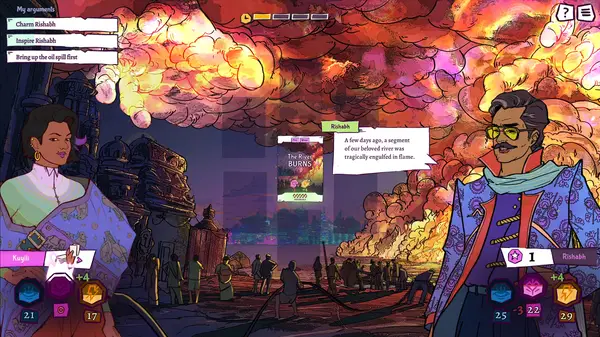
The world behind the cards
All Will Rise isn't just about saving trees. It's a story about a dead river. It's about the people who lost everything because of greed. You play as Kuyili. She's a lawyer. She wants justice for that river. But the law has limits. Sometimes, the law is just a tool for the people in charge.
The game takes place in Muziris. It's not our world, but it feels close. The team drew inspiration from India. They want to show struggles that don't make the evening news. You aren't fighting from a comfortable couch. You are fighting in the dirt. You are fighting in the dark.
Narrative director Meghna Jayanth knows this stuff well. She talks about the Adivasi people. These are indigenous groups fighting for their land. They don't have cameras. They don't have a global audience. They have to survive. Sometimes, that means fighting back with more than just words.
The game asks a tough question. Is nonviolence a luxury? If you're starving, do you ask for a seat at the table? Or do you take the table? The team isn't giving you an easy answer. They want you to find it yourself.
Choosing your path in the storm
The core gameplay is a mix of debate and action. You have a deck of ideas. You use them to persuade people. You use them to challenge the status quo. But you also have Kottavai. She's different. She's a folk performer. She channels a god. She isn't interested in a polite chat.
Kottavai is the radical edge. She believes in direct action. She believes in violence if that's what it takes to stop the machine. She is the shadow to Kuyili's light. Both are necessary. At least, that's what the developers think. They see a need for both the diplomat and the rebel.
The team at Speculative Agency wants a coalition. They don't want you to pick one hero. They want you to see why people choose different paths. Some people need to be the voice of reason. Others need to be the force of nature. It's a messy, complicated web of choices.
They expect pushback from Western players. People here are used to the idea that protest must be polite. We're taught that if we just hold signs and march, things will change. Speculative Agency thinks that idea is broken. They are pointing to the reality of the Global South. Things are different there. The stakes are higher.
They aren't trying to promote terrorism. They are trying to show why it happens. They want to show the desperation behind the headlines. It's about the "murder of a river" and the people who can't just stand by and watch. It's a game about accountability. It's about holding the powerful to the fire.
You'll spend a lot of time debating. You'll be challenged. You'll have to defend your own moral compass. If you go in thinking you have all the answers, you're in for a surprise. The game will push back. It will make you feel uncomfortable. That is the point.
Inside the mechanics of dissent
Technically, the game is a deckbuilder. But it's not about goblins or spells. It's about social capital. It's about rhetoric. You build your deck by unlocking new ideas. You upgrade them to make your arguments stronger. It's a game of wits.
The design director, Hugo Bille, points to the movie How to Blow Up a Pipeline. That film caused a stir. People were scared of it. They thought it would start real-world violence. All Will Rise is in that same vein. It's art that mirrors the boiling point of our actual world.
The mechanics reflect the theme. You have to balance your influence. You have to decide when to be a lawyer. You have to decide when to be an activist. Every card you play changes the world in Muziris. It's a system built on consequence. You can't avoid the fallout of your actions.
The UI and the art style support this. Everything feels urgent. The stakes are always high. You aren't playing for high scores. You are playing for the future of your home. It's a tight, focused experience that doesn't waste your time with filler.
Why this game matters now
We live in a time of collapse. The world is burning. People are angry. All Will Rise captures that mood. It's not just a game; it's a mirror. It's holding up a light to the things we don't want to see. It's going to make some people very angry. That's probably a good sign.
The team doesn't want everyone to agree. If everyone is happy with the story, they failed. They want a debate. They want the players to leave the game and talk. They want to break the idea that activists are just "boring" people in sandals. They want to show that activism is raw, human, and vital.
This is a game for people who want to think. It's for people who are tired of the same old hero stories. It's for the people who look at the news and feel a knot in their stomach. It's a game that asks you to take a side. And then it asks you to defend it.
Whatever happens, All Will Rise won't be ignored. It's a loud, messy, and necessary piece of work. It's the kind of game that sticks with you long after you turn off the screen. It's a call to look at the world differently. Are you ready for that?
Quick questions answered
Is this a typical deckbuilder? No. While the mechanics are familiar, the goal is to win arguments, not just health points. It's a narrative game at its heart.
Does the game promote violence? The developers say it explores the topic. It doesn't tell you what to think. It presents the reality of activists in high-stakes situations.
Where does the game take place? It is set in Muziris, a fictional city inspired by India. It's not a direct history lesson, but it pulls from real struggles.
Can I play as a non-violent character? Yes, you play as Kuyili, a lawyer. You can try to work within the system. But the game will challenge your methods.
Why is the team expecting pushback? Because the game discusses ecoterrorism and radical activism. Some audiences in the West prefer a very narrow view of protest.
What i think
I think this game is going to be a lightning rod. Honestly, the gaming industry usually avoids this kind of heat. Most studios want to sell to everyone. Speculative Agency doesn't care. I respect that. It's refreshing to see a team take a stand.
The thing that gets me is the focus on the Global South. We spend so much time in games looking at the "imperial core." It's nice to see a story that centers on people who are on the front lines. It makes the stakes feel real. It makes the conflict feel necessary.
I think the debate over nonviolence is a trap. I like that the game refuses to fall into it. It's easy to judge someone from a position of safety. It's much harder to live through the struggle. I'm really curious to see how the game handles this nuance. It's a tightrope walk.
Honestly, I'm ready for a game that doesn't treat me like a child. I want to be challenged. I want to be annoyed. If All Will Rise can deliver on its promises, it will be one of the most important games of the year. I'm definitely going to play it.