Gary Larson and the Obsession with Prehistoric Wheels
Explore why Gary Larson obsessed over the invention of the wheel in his classic comic, The Far Side. We look at his funniest prehistoric gags.
I still laugh when I see a The Far Side panel. It's the simple lines. It's the weird, dry, and often dark wit. Gary Larson found something special in the distant past.
He loved to poke fun at the dawn of man. Specifically, he was obsessed with the wheel. Why did he keep going back to it? It's easy. It's the ultimate human invention.
Larson turned that invention into a playground. He made it silly. He made it painful. He made it human. Let's look at why his stone-age jokes still land so well today.
When the stone age met modern absurdity
Most people think of history as a dry list of dates. Larson saw it as a punchline. He took the stone tools and the caves and added a modern twist. His cavemen weren't just grunting. They were frustrated. They were stressed. They were, honestly, just like us.
The wheel was his favorite target. Think about it. It changed everything. So, naturally, he had to ruin it. He stripped away the glory. He replaced it with failure and bad luck. It's a classic comedic move.
He didn't need fancy setups. He had a cave, a rock, and a guy with a bad idea. That's all he needed to build a legend. He proved that you don't need much to be funny. You just need a sharp mind and a lot of ink.
The comedy of failed innovation
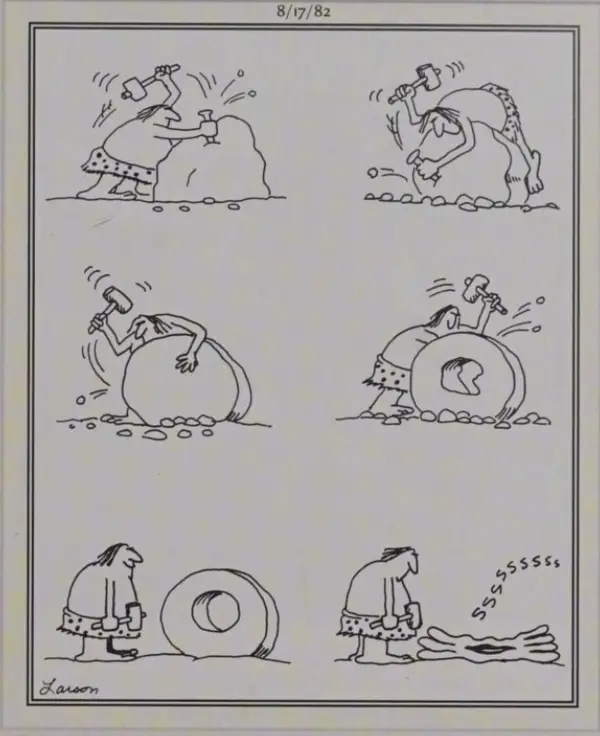
Let's talk about that famous 1982 panel. You know the one. A guy carves a wheel. It looks perfect. Then, it deflates. It makes that "ssssss" sound. It's brilliant. It's a rock, but it acts like a tire. That is the peak of cartoon logic.
Then there's the pterodactyl incident. A guy spends all day cleaning his new invention. Then, a giant bird ruins his hard work. It's relatable. We've all had those days. You finish a big job, and life just wrecks it. It's funny because it's true.
Some of his best work was silent. Look at the cavemen cruising in a car. One guy is stuck with a chisel. He's still working on the wheel. His friends are already driving away. The look on his face says it all. He missed the boat. Or, in this case, the car.
Trials were also a big part of his humor. He showed a guy tied to a wheel. It's an experiment. A guy with a notepad watches. It's dark, for sure. But it's also a great look at the cost of progress. Someone had to be the test dummy.
Larson also loved the mechanic life. He had a comic where a guy rants about tools. He's mad about the selection. It feels like a shop today. He turned a prehistoric garage into a setting for common, everyday annoyance.
The technical art of the single panel
Larson didn't use big, messy backgrounds. He kept it clean. He focused on the characters. He made sure the reader knew exactly what was happening. It's a masterclass in visual storytelling.
His captions were always short. He never explained the joke. He just set the stage. He let the drawing do the heavy lifting. That is hard to do. Most artists talk too much. He knew when to stay quiet.
The pacing was key. In the six-part strip about the deflating wheel, he controlled the eye. You follow the steps. You see the work. Then, the payoff happens at the end. It's a perfect rhythm.
Why these jokes never get old
We love these comics because they are timeless. The tools change, but the people stay the same. We still get frustrated. We still try new things. We still fail. Larson captured that cycle.
He gave us a mirror. When we laugh at a caveman, we laugh at ourselves. the past. is about how we live now. That's why people still buy his books decades later.
He didn't follow trends. He didn't care about being cool. He cared about being funny. And he succeeded. He changed how we look at comics. He made the funny pages feel smart again.
Common questions about the far side
Was Gary Larson a historian? No, he just had a great sense of how the world works. He used history as a prop for his humor.
Why did he draw so many animals and cavemen? He found them to be blank slates. They let him tell jokes about human nature without using real people.
Are these comics still in print? Yes, you can find his collections in bookstores everywhere. They are staples of the medium.
Did he ever explain his jokes? Rarely. He believed that if you have to explain it, the joke is already dead.
How many panels did he draw? Thousands. His career spanned many years, and he was prolific until he retired.
My take on larson's genius
I think Larson is the king of the single panel. I grew up reading his books. They sat on my coffee table for years. I still pick them up when I need a laugh.
The thing that gets me is his timing. He knew exactly when to cut the image. He never let a joke drag. He hit the point and got out.
I honestly think modern comics have lost that touch. Everything feels too busy now. It's all about complex arcs and big drama. Larson proved that a guy with a rock is all you need.
I admire his focus on the bit. He didn't just do one wheel joke. He did dozens. He kept finding new angles on the same old rock. That is true creativity.