Intel Battlemage Arc Pro B70 Benchmarks Reveal a GPU That Missed the Mark
We analyze the Intel Arc Pro B70 benchmarks to see why this massive chip failed to compete in the gaming market.
The mystery surrounding the Intel Battlemage Arc Pro B70 has finally come to a close. For months, hardware enthusiasts wondered if this giant chip would shake up the desktop gaming world. We wanted a new challenger to face off against the big players. Instead, we got a specialized tool that ignores the needs of most gamers.
Recent testing shows the card performs like an Nvidia RTX 5060 Ti. That is not a terrible result for a mid-range card. However, when you look at the physical size of the silicon, the picture changes. This chip is massive, expensive to build, and ultimately inefficient for the task of rendering games.
It is rare to see a piece of hardware with this much potential land so wide of the target. We have the data now. Let us break down why this experiment failed to launch for the gaming crowd and what it means for the future of Intel graphics.
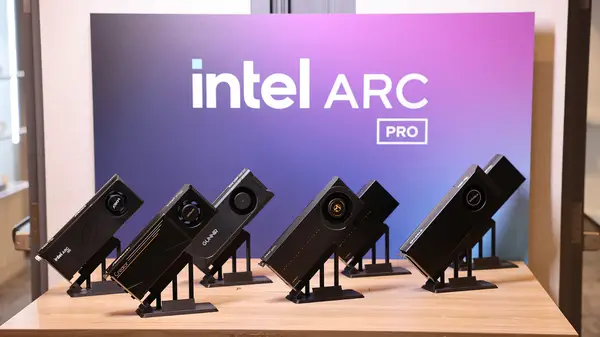
The story behind the battlemage G31 architecture
To understand the B70, we have to look at the G31 silicon. This chip is the larger sibling to the G21 GPU found in the Intel Arc B580. Intel calls this generation Battlemage, or Xe2. It is their second serious swing at building a dedicated graphics architecture from the ground up.
When the leaks first appeared, everyone assumed this was the secret weapon for gaming. We expected high frame rates and strong ray tracing performance. Intel had other plans for the chip, though. They decided to load it with 32 GB of VRAM and target the growing market for local AI tasks.
It is a niche move. By selling it as a workstation card at a price around $1,000, they avoided the brutal competition of the consumer gaming market. They knew the card could not win on price or power efficiency. This strategy keeps the product alive, but it leaves gamers wanting more.
Benchmarking the B70 against modern rivals
German outlet PCGamesHardware recently put the Arc Pro B70 through a gauntlet of modern titles. The results were clear. In standard raster gaming, the card hits the same marks as an Nvidia RTX 5060 Ti 16 GB. It is a competent performer, but it is not a powerhouse.
Things get worse when you turn on advanced features. Once you enable ray tracing or path tracing, the performance lead of the competition grows. The B70 simply cannot keep up with the cards we expected it to beat. It is definitely not the RTX 5070 killer we hoped to see.
The disappointment is real. We spent months tracking rumors and hoping for a disruptor. We wanted a card that forced Nvidia to lower prices or increase performance. Instead, we got a chip that struggles to justify its own existence in a gaming rig.
The "instructive" part of this story is the most important. Why did Intel pull the plug on a gaming version? The answer lies in the physics of the chip itself. The B70 is a large piece of silicon, measuring 368 mm2 on a TSMC N5-class node.
Compare that to the Nvidia GB206, which powers the RTX 5060 Ti. That chip measures just 181 mm2. That is less than half the size of the G31. Smaller chips cost much less to manufacture and generate less heat, which is a massive advantage.
Intel essentially built a massive, expensive engine that only delivers average speed. Even if they optimized the drivers to perfection, the math would never work. The cost of production is too high for the output they provide to a gamer.
Technical limitations and silicon efficiency
The G31 chip has 32 Xe cores, which is a 60% increase over the 20 cores in the G21. Despite that massive hardware leap, the performance gain in games is only about 34%. This shows that the architecture does not scale well when pushed to these sizes.
Meanwhile, an RTX 5070 is 87% faster than the G21. Even with perfect scaling, the G31 would struggle to catch up to mid-range cards. The silicon is just not efficient enough for the high-end gaming market. It is a non-starter for anyone building a serious gaming PC.
We have to talk about the die size again. The G31 is almost as large as the RTX 5080 GPU, which measures 378 mm2. Imagine paying for the size of an 80-class card but getting the performance of a 60-class card. No consumer would ever pay for that deal.
Intel's decision to hide this card in the workstation market was a smart move to save face. It is a functional piece of hardware for AI work, but it is not a gaming GPU. The technical hurdles they face are significant, and they still have a long way to go.
What this means for intel graphics
This result shows how far ahead Nvidia is for efficiency. Nvidia has mastered the art of extracting massive performance from small amounts of silicon. Intel is still learning how to balance their core counts with actual gaming output.
Does this mean Intel should quit? Not necessarily. They have the resources to keep trying. However, the Battlemage era has been a rough ride. They need to focus on smaller, more efficient designs if they want to earn the trust of the gaming community.
We should also consider the driver situation. Intel has improved their software over the years, but it cannot fix a hardware flaw. If the chip is too big and too expensive, no amount of software magic will save it. We need to see better hardware design in the next generation.
Frequently asked questions
- Is the Intel Arc Pro B70 good for gaming? It is capable of running games, but its performance is equivalent to an Nvidia RTX 5060 Ti. It is not an ideal choice for high-end gaming.
- Why is the B70 so expensive? The card is designed for professional AI tasks and includes 32 GB of VRAM, which drives up the manufacturing cost.
- Will Intel release a gaming version of the G31 chip? No. Intel has positioned this chip specifically for workstation and AI use cases due to its size and cost.
- How does the B70 compare to the RTX 5080? The B70 uses a similar amount of silicon as the RTX 5080 but performs significantly worse in gaming scenarios.
- Are the drivers for Battlemage optimized for games? Intel continues to work on drivers, but the hardware limitations of the G31 chip prevent it from competing with modern high-end GPUs.
Expert take: my perspective
I think the most frustrating thing about the Arc Pro B70 is the wasted potential. We have been waiting for a third player to enter the GPU market for years. Seeing a company like Intel struggle to scale their architecture is just painful for those of us who want more options.
The thing that gets me is the sheer size of the G31 chip. When I look at the die size comparison, I see a missed opportunity. Intel clearly put a lot of engineering time into this, but they focused on the wrong metrics. They built a giant, power-hungry card that misses the mark for the average player.
I feel like Intel is playing catch-up while Nvidia is running a marathon. Nvidia's efficiency is honestly scary. They know exactly how to shave off every millimeter of silicon to keep costs down while pushing performance up. Intel needs to stop trying to brute-force their way to the top.
If I were running the show at Intel, I would stop chasing the high-end for a moment. Focus on making a small, efficient, and cheap card that dominates the budget sector. Build a reputation for value first. Once you have a foothold, then you can start dreaming about taking on the big dogs again.