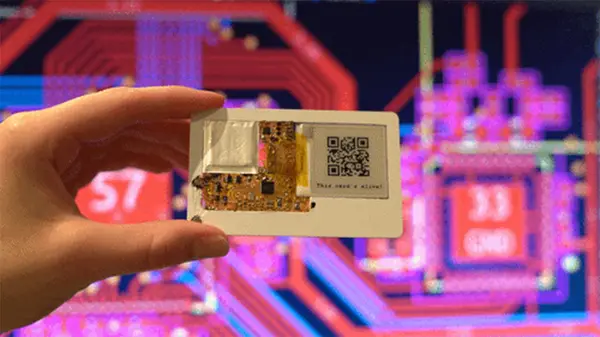
The Muxcard Is a Tiny Credit Card Computer That Actually Fits in Your Wallet
Discover the Muxcard, a 1mm thin credit card computer powered by the ESP32-C3 microcontroller, featuring an eInk display and NFC capabilities.
The dream of a fully functional computer that fits inside a wallet has haunted gadget lovers for decades. We have seen countless attempts to shrink desktops into pockets, but they often end up as bulky bricks. Most projects sacrifice the essential slim profile of a standard credit card to cram in more hardware. The Muxcard changes that narrative by pushing the limits of physical space. It measures just 1mm in thickness, hovering dangerously close to the standard ID-1 card dimensions defined by global standards. This isn't just a dummy prop for a sci-fi movie; it is a working, programmable machine. Seeing a functional display refresh on a surface as thin as a piece of plastic feels like magic. It forces us to rethink what we define as a computer in the age of massive data centers. This project proves that raw power matters less than clever engineering when space is at an absolute premium.
The long history of pocket-sized computing
Miniaturization has been the primary goal of the tech industry since the birth of the transistor. We started with machines that filled entire rooms. Then came the era of the personal computer, followed by the mobile revolution. The credit card form factor has always been the final boss of portable design. In the past, devices like the REX attempted to solve this problem by offering a thin, PDA-like interface. These early machines were impressive, but they lacked the connectivity we demand today. They were islands of data, unable to talk to the wider world without a cumbersome docking station. Modern makers now have access to much better tools. The rise of the ESP32 series changed everything for hobbyists. We can now pack Wi-Fi, Bluetooth, and powerful processors into tiny packages that cost pennies. This shift allows a single person to build what once required a multi-million dollar R&D budget.
Building a working computer on a plastic chassis
The Muxcard project, shared by the creator known as krauseler on GitHub, is a masterclass in compromise. To achieve that 1mm thickness, the creator had to strip away anything unnecessary. The chassis itself is a repurposed NFC card with the guts carved out to make room for components. At its heart lies the ESP32-C3, a RISC-V microcontroller. It is not an Intel Core i9, but it is enough to handle basic logic and connectivity. It manages the ePaper display, which is the real star of the show. This screen uses almost no power once the image is set, making it perfect for a card-sized device. The prototype includes an LIS2DW12 accelerometer for motion sensing. This means the card knows when it is picked up or moved. It also has an RC522 NFC module, turning the card into a legit tool for authentication or data exchange. It is not just a passive tag that sits there; it can actively write and read data. Powering this tiny beast is a 30mAh LiPo battery. It is laughably small compared to a smartphone battery, but it matches the scale of the device. The maker is currently searching for even thinner cells to ensure the final version stays perfectly flat. It is a constant battle against the laws of physics. Challenges remain for the project. The current prototype is fragile and lacks some features common in modern hardware. The plan includes adding a USB Type-C port for easy charging and data transfer. A microSD card slot is also on the roadmap to expand local storage, which is currently limited by the chip's internal memory. The maker invites others to jump in and help improve the design. By keeping the files on GitHub, they ensure that this is a community effort. It is not about selling a product; it is about proving that we can make hardware this thin if we really want to.
Granular hardware specs and design limits
The ESP32-C3 is the engine driving this device. It features 320KB of SRAM and 384KB of ROM. This is modest by modern standards, but it is plenty for running custom firmware focused on single tasks. It handles the Wi-Fi stack and the display updates without breaking a sweat. The 1.54-inch flex ePaper screen provides a 200x200 pixel resolution. Because it is a flexible panel, it is far more durable during the assembly process than a glass display would be. It supports partial updates, meaning the screen can change a small portion of its pixels without a full flicker. Physical durability is the biggest hurdle. A 1mm card is naturally prone to bending. The internal components are rigid, so any flex in the card could crack the battery or the display ribbon cables. The creator is looking into ways to ruggedize the internal frame without adding weight or thickness. Future iterations might swap the processor for an ESP32-S3 or an nRF52 series chip. These chips offer more power and better power management. However, every change requires a total redesign of the PCB layout. It is a slow, iterative process of trial and error.
The future of wallet-sized tech
What is the point of a computer the size of a credit card? Some might call it a toy, but the potential uses are clear. It could serve as an offline vault for 2FA codes. It could act as a smart-home controller that you carry in your pocket. We are entering a phase where the boundary between hardware and physical objects is blurring. If you can build a computer into a card, why not build it into a clothing tag or a piece of jewelry? The only limit is how small we can make the battery and the interface. This project shows that the "smart" revolution does not always need a screen the size of a tablet. Sometimes, the best tech is the kind you forget you are carrying. If the Muxcard succeeds, it will pave the way for a new generation of ultra-thin, personalized devices.
Frequently asked questions
Is the Muxcard a general-purpose computer?
No, it is a specialized microcontroller device. It does not run a full operating system like Windows or Linux, but it can run custom programs for specific tasks. Can I buy a finished Muxcard?
Not yet. The project is currently a DIY prototype. You can find the plans on GitHub, but you will need to source the parts and assemble them yourself. How does the card charge?
The current prototype uses a 30mAh LiPo battery. The developer is planning to add a USB Type-C port in future versions to make charging much easier. Is the screen always on?
No. The ePaper screen is bistable. This means it only uses power when the image changes. Once the display is set, it stays that way even if the battery dies. What can the NFC chip do?
The RC522 module allows the card to read and write to other NFC tags. It can act as a key, an authenticator, or a tool for sharing small amounts of data.
Expert take: my perspective
The thing that gets me about the Muxcard is how it refuses to compromise on the physical form factor. We live in a world where tech companies tell us that "thinner" is impossible unless you spend a fortune. This project proves that a person with a soldering iron and some patience can beat the big guys at their own game. I think we have lost the spirit of hacking hardware for the sake of it. Everything today is a sealed black box. When I see a project like this, I see a return to the roots of computing. It reminds me of the era when people built computers from kits because they wanted to understand how the electricity moved through the board. The limitation of 1mm is the most interesting part of this design. It forces the builder to be creative with component placement. It is not about adding more features; it is about making the features you have fit in a tiny space. That is a design constraint that produces better, more focused devices. I would love to see this evolve into a standard platform for others to build upon. If we had a modular, credit-card-sized board, the possibilities would be endless. I am rooting for this project to move past the prototype stage and into something that more people can build and enjoy.