Samsung Chip Strike Risks and the Future of Memory Production
Samsung faces a massive potential strike as labor negotiations stall. Discover how this conflict impacts global chip supply and HBM production.
The roots of the labor conflict
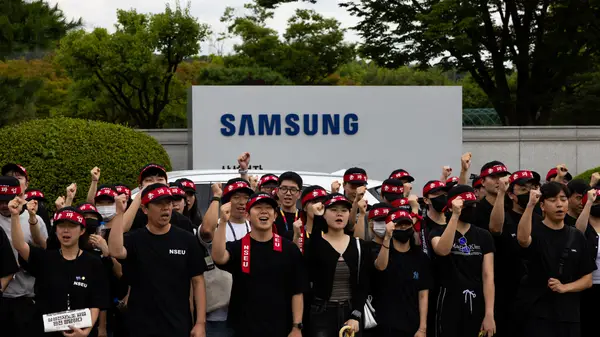
Labor relations at major South Korean tech firms have historically been quiet. For decades, companies like Samsung operated with a top-down approach that discouraged collective bargaining. That era has ended. The rise of the Super Enterprise Union reflects a shift in how younger engineers view their roles. They no longer accept long hours and rigid hierarchies without a fair cut of the revenue. The current dispute centers on a fundamental disagreement about performance bonuses. The union wants a transparent formula. They argue that employees should receive a set percentage of operating profits. Management, however, prefers to keep these payouts at their discretion. They want to maintain control over the budget to weather market volatility. Previous mediation attempts in February and March failed to bridge this gap. Both sides reached an impasse that left little room for compromise. Now, with government-mediated talks on the table, the pressure is immense. If these talks fail, a planned general strike starting May 21st could paralyze production for weeks.The anatomy of a potential stoppage
A strike at a facility as complex as a semiconductor fab is not like closing a retail store. These machines run 24/7. Shutting down production lines involves precise sequences to prevent damage to sensitive equipment. A sudden walkout could ruin batches of wafers worth millions of dollars. When a one-day strike occurred in April, the results were sobering. Output for memory chips fell by 18 percent during the night shift. Even worse, the contract foundry output dropped by 58 percent. These numbers show that even a short interruption creates a massive hole in the supply chain. The union currently claims around 73,000 members. If 40,000 workers participate in a walkout, the impact will be catastrophic. The company would struggle to maintain even basic operations. This is why analysts warn that an 18-day strike could lead to a massive shortfall in revenue and profit. The scale of the risk has grown significantly since the first labor actions in 2024.Technical hurdles and HBM production
The most critical area of concern is High Bandwidth Memory, or HBM. This technology is the backbone of modern AI infrastructure. Without a steady supply of these chips, the companies building the next generation of powerful software will hit a wall. Samsung is a key player in this space. Any disruption here ripples across the entire tech sector. The union demands are tied to the massive profits expected from these advanced products. They point to competitors like SK Hynix, which have offered significant bonus packages to retain top talent. When engineers see their peers at rival firms getting paid more for the same high-pressure work, they start to look for the exit. Management has offered a one-time bonus of $340,000 to keep the peace. The union rejected this. They view it as a temporary fix to a structural problem. They want a permanent change to the compensation model. Without that change, the brain drain of engineers to rival firms will likely continue, further weakening Samsung's long-term position.Market fallout and
The financial consequences are hard to ignore. JPMorgan analysts suggest that if Samsung meets the union demands, annual operating profit could drop by 12 percent. This is a tough pill for shareholders to swallow. However, the cost of a full-scale strike is arguably much higher. The ripple effects in global pricing would be felt by every consumer buying a new computer or phone. Internal divisions within the workforce complicate the situation. The union is dominated by workers from the semiconductor division. Employees in the smartphone and appliance divisions feel left out. This has led to thousands of workers leaving the union. It creates a fractured labor force that is harder for leadership to manage and harder for management to negotiate with. Ultimately, this is a test of corporate culture. Samsung must decide if it wants to maintain its traditional structure or adapt to a new reality. If they cannot find a way to reward their workers, the cost of talent will eventually exceed the cost of the bonus demands. The industry is watching this closely, as it sets a precedent for how other major tech firms handle their own labor relations.Frequently asked questions
- Why is a Samsung strike so dangerous for the tech industry? Samsung is a dominant supplier of memory chips. A strike halts production, which limits supply and drives up costs for every company that buys their chips.
- What is the main demand of the union? The union wants to uncap performance bonuses and link them directly to a percentage of the operating profit.
- How did the April strike affect output? The one-day strike caused memory fab output to drop by 18 percent and foundry output to plummet by 58 percent.
- What is HBM and why does it matter? High Bandwidth Memory is essential for AI hardware. A shortage of these chips slows down the development of advanced computing systems.
- Can Samsung just replace the striking workers? Semiconductor manufacturing requires highly specialized skills. Replacing thousands of trained engineers and technicians is impossible in the short term.
Expert take: my perspective
I think the core issue here is a failure of leadership to recognize that the era of the "company man" is dead. You cannot demand extreme productivity from your engineers and then keep them in the dark about how that value is shared. The math the union is using might be aggressive, but it is a direct response to the massive success of the products those workers build.
The thing that gets me is the comparison to competitors. When your best engineers are walking out the door to work for your biggest rival because the pay is better, you have already lost the battle. Money is not the only factor, but it is the baseline for respect. Samsung has relied on its brand name for too long to keep people in line.
I believe the government mediation is a sign that everyone realizes how high the stakes are. A twenty-billion-dollar loss is not something the South Korean economy can brush off. If they don't reach a deal, the damage to the brand will be long-lasting. People will stop seeing Samsung as a stable, reliable partner.
If I were in the boardroom, I would stop fighting the bonus structure and start building a new way to share the wealth. It is better to pay your workers more than to lose your production capacity for three weeks. The market will forgive a dip in profits, but it will not forgive a failure to deliver the hardware that runs the world.