88 Years Later, Superman's Original Origin Story Is DC Canon Again
Discover how DC Comics is merging Superman's 1938 orphanage origin with his iconic Smallville upbringing in a new, clever narrative twist.
Think you know the start of the Superman story? Most of us do. A ship falls from the sky. A farm couple finds a baby. They raise him in Smallville. It feels like a fact carved in stone. But comics have a funny way of changing the rules.
Sometimes, the past isn't as settled as we believe. Writers love to tinker with the classics. They peel back layers of history to see what sticks. It turns out, that first version of the Man of Steel was quite different.
I find this shift fascinating. It shows how stories evolve over time. We aren't just getting a reboot. We are getting a bridge between two eras. Let's look at how DC is stitching these pieces together.
The old days and that first orphanage run
Way back in 1938, the world met Superman for the first time. The pages of Action Comics #1 didn't feature a cozy Kansas farm. Instead, the infant arrived on Earth and ended up in a home for orphans. It was a cold, lonely start for a hero who stands for hope.
Fans grew used to the farm life later on. The Kents became the heart of his growth. They taught him values. They kept him grounded. That farm life is now the standard for almost every version of the character we see.
Yet, the original plan was different. He didn't have a family at first. He had a room in a building full of other kids. It lacked the warmth of the Kent household. It painted a picture of a hero forged by the system rather than by love.
For decades, this was just a trivia point. It was a footnote in a long history of capes and tights. Most readers ignored it. They wanted the farm. They wanted the cornfields. But memories of that first story never truly died in the offices of DC.
Mixing two worlds into one new truth
Now, things are changing. Mark Waid is steering the ship in Action Comics #1098. He wants to honor the past while keeping the present intact. He does this by blending the two stories. It is quite a clever trick.
The story takes place in the past. Superboy is searching for his lost ship. He needs help. He turns to the Kents for answers. They have to tell the truth about that day. The tension in the room is high.
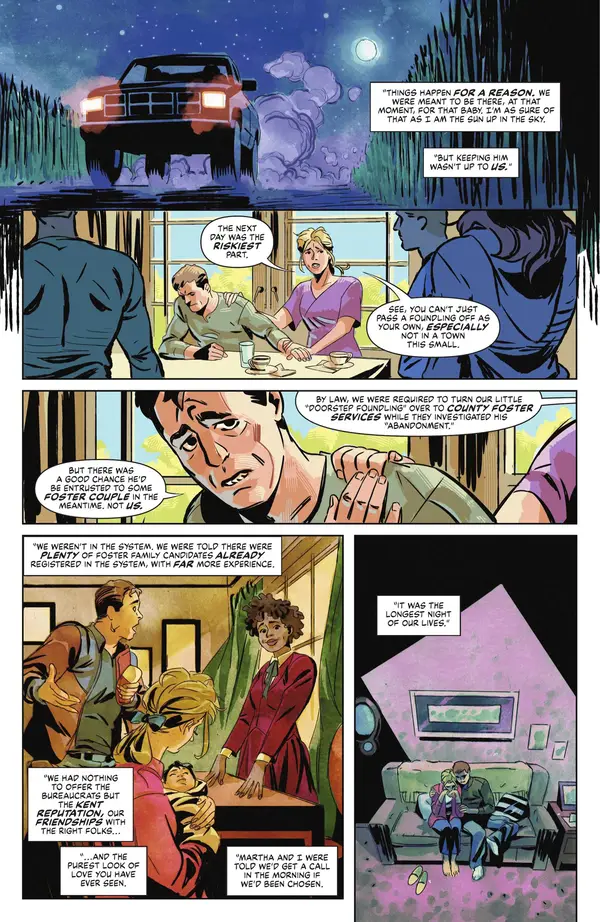
Jonathan Kent admits they kept the ship hidden. They didn't want the government to take the boy. They were scared. They wanted a son. So, they hid the evidence in the barn. It feels very human.
But they couldn't hide a baby forever. They knew they had to follow the law. They reported the child as an abandoned infant. They went to the local office to file the papers. It was a risk. The system could have taken him away.
For one long night, the boy was officially in the system. He was a ward of the state. He wasn't a Kent yet. This tiny gap in time bridges the 1938 origin with the modern one. It's a smart way to keep both versions valid.
The agency eventually gave him back. The Kents had a good name. They had the right heart. They won the fight to keep him. It feels earned. It doesn't throw away the farm life; it adds a layer of doubt that makes the victory sweeter.
The mechanics of a canonical shift
Mark Waid uses this moment to show the stakes. The Kents weren't just lucky. They were desperate. They had to navigate a world that wanted to study the ship. They had to play by the rules to protect their son.
This adds weight to their choice. It wasn't just a simple act of kindness. It was a legal battle. It was a test of their resolve. They almost lost him before they even got to raise him. That is a heavy thought.
The art by Skylar Patridge and Patricio Delpeche makes it feel grounded. They capture the anxiety of the Kents perfectly. You can see the fear in their eyes. The barn scene feels cramped and tense. It isn't the sunny farm we expect.
This integration is smooth. It doesn't force the reader to pick a favorite origin. It says both are true. It says the boy was once a stray in the eyes of the law. Then, he became a son.
Why this changes how we see the man of steel
Does this change Superman? In some ways, yes. It reminds us he was vulnerable. He was a number on a page for a few hours. That makes his bond with the Kents feel stronger. They were his first choice, but he was almost not theirs to keep.
It also gives a nod to the long history of the character. 88 years is a long time for any hero. DC is clearly looking back to move forward. They are finding ways to make the old fresh again.
I think this is a great move. It respects the fans who know the history. It also gives new readers a reason to care about the past. It turns a piece of trivia into a story beat. That is the mark of a good writer.
We will see if this sticks. Canon in comics is always in flux. But for now, this feels right. It ties the knot between the 1938 Action Comics and the modern myth. It makes the legend feel whole.
Quick questions answered
Is the orphanage origin totally back? Not exactly. It is now a temporary legal status. He was in the system for one night.
Does this mean the farm origin is gone? No. He still grows up on the farm. The Kents successfully adopt him after the legal process.
Why did the Kents do this? They feared the government would experiment on the ship and the baby. They needed a way to keep him safe.
Who wrote this story? Mark Waid wrote this in Action Comics #1098. He is known for deep dives into history.
Can I read this now? Yes. Action Comics #1098 is available to read. You can pick it up at your local shop or online.
My honest take on this
Honestly, I love when writers do this. It is so easy to ignore the weird bits of the past. Most writers just want to ignore the 1938 stuff. They think it's too old. Mark Waid proves that you can make it work if you try.
I think the best part is the emotional stakes. We always assume the Kents just took him home. But the idea that they had to fight for him? That makes me like them more. It makes them active heroes in their own right.
The thing that gets me is the tension. I felt nervous reading the scene. Even though I knew he ends up on the farm, the risk felt real. That is a hard thing to pull off with a character who has been around for 88 years.
I hope we see more of this. I want to see how other parts of the myth get updated. There are so many old stories that deserve a new look. If they can make this work, they can make anything work.