Googlebook: The New Laptop Platform Ready to Replace Chromebooks
Google is set to launch Googlebook, a new laptop platform powered by Android and Gemini AI, designed to replace the aging Chromebook series.
I remember when the first cheap laptops hit the market. They were slow. They felt like toys. You could barely open two browser tabs without the whole thing freezing up.
But things change. Now, we are looking at a massive shift in how we use mobile tech on our desks. The news about the new Googlebook are finally starting to make sense to me.
It's not just another budget machine. It's a full rethink of the hardware we use every day. If you want to know what's coming next for your laptop, keep reading.
From browser tabs to real systems
For years, Chromebooks occupied a weird middle ground. They were great for schools. They were fine for basic tasks. But they always felt like a limited version of a real computer.
The OS was just a web browser. If you wanted to do real work, you were stuck. You couldn't install apps like you would on a normal PC. It was a bottleneck for anyone with actual ambition.
Now, they are finally fixing this. By moving to Android, the new Googlebook platform aims to bridge that gap. It's a move that should have happened five years ago.
The industry knows the hardware needs to grow up. People don't want a browser in a box anymore. They want a device that feels like a phone but acts like a workstation.
What the leaks tell us
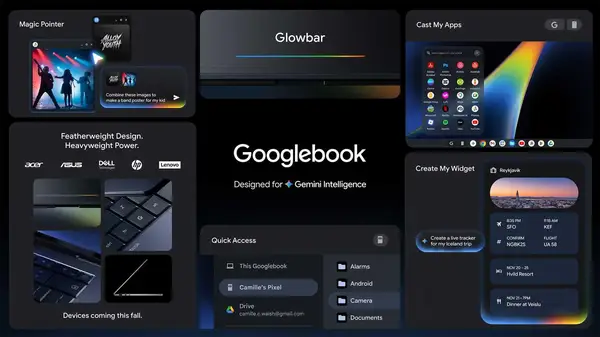
The leaked images show a system that finally puts Android front and center. It's not a skin. It's the whole OS. This means your phone and your laptop can finally talk to each other properly.
You can see your phone files right on the screen. It's a small detail, but it changes everything. No more emailing files to yourself. No more cloud syncing headaches.
Then there is the Gemini integration. It's everywhere. You can ask the system to build widgets for you on the fly. Need a travel planner? It pulls your flight, your hotel, and your calendar into one view.
The "Magic Pointer" is another wild feature. It knows what you are looking at. You can drag images together and let the AI blend them. It's context-aware in a way that feels almost creepy.
The hardware itself looks sleek, too. The Glowbar at the top of the lid is a nice touch. It lights up when you talk to the AI. It's a visual cue that the machine is listening.
It's clear this isn't just a software update. It's a new way to interact with your data. The goal is to make the computer feel less like a tool and more like an assistant.
The hardware partners
Don't expect Google to build these machines themselves. They are sticking to the old playbook. They want Asus, Dell, HP, Lenovo, and Acer to do the heavy lifting.
This keeps costs down. It also keeps the variety high. You'll have cheap plastic models and expensive metal ones. It's the same variety we see in the current market.
But the OS will be the same across all of them. This is the "Aluminum OS" project we've heard about for ages. It's the final push to kill off ChromeOS for good.
By using standard PC makers, they ensure that these laptops get into the hands of real people. It's a smart move. They don't need to learn how to manufacture laptops when others do it better.
A future built on AI
The question is price. If these machines cost as much as a MacBook, will people buy them? Probably not. The whole point of the Chromebook success was the entry price.
If they can keep the price low, they have a winner. If they get greedy, they'll lose the market to cheap Windows machines. The AI features must be worth the cost.
We'll see what happens on Tuesday. I expect a lot of hype. But the tech under the hood is what matters most. I'm curious to see if the Android base holds up under pressure.
This is a make-or-break moment for their laptop strategy. They need to prove that Android can handle pro work. If it can, the laptop market is about to get very interesting.
Quick questions answered
Is this just a new Chromebook? No. It's a new platform called Googlebook. It uses Android, not ChromeOS.
Can I still run my old web apps? Yes. Since it's based on Android, web support is still a core part of the experience.
Will these be expensive? That depends on the manufacturer. Google is leaving the pricing to partners like Dell and HP.
Does it work with my Android phone? Yes. The integration is a core feature. You can access phone files directly on the laptop.
When can I buy one? We expect more details at the I/O event this Tuesday. Release dates should follow shortly after.
My honest take on this
I think this is long overdue. I have used Chromebooks for years, and I always hit a wall. The software was never quite enough for my daily grind. Moving to Android feels like the right move.
But I am worried about the bloat. If they fill these machines with too much Gemini fluff, it might kill performance. I want a fast machine, not a chatty one. I hope they keep the AI out of the way when I'm trying to work.
The Glowbar looks cool, but I don't know if I want my laptop lid glowing every time I talk to the AI. It feels a bit gimmicky to me. I prefer a clean, quiet workspace over a light show.
Honestly, my take is that this will be a massive hit if the price stays under $500. Anything more than that, and they are competing with real computers. I'm waiting to see the first benchmarks before I get too excited.