NASA’s Mars Rotor Technology Breakthrough Enables Future Exploration
Engineers at NASA’s Jet Propulsion Lab have successfully tested rotor blades at supersonic speeds, paving the way for advanced Mars helicopters.
The thin, wispy air of Mars has always been a nightmare for flight engineers. To stay aloft, a vehicle must move fast and work hard. For a long time, we thought we hit a ceiling on how fast rotor blades could spin before they shattered.
NASA just proved us wrong. By pushing their new rotor designs past the sound barrier in a vacuum chamber, the team at the Jet Propulsion Laboratory opened up a new chapter for space travel. This is not just a small tweak to an existing design.
It is a total shift in how we think about exploring other planets. If we can fly faster and carry more, we can see more of the red planet than ever before. The era of the heavy-lift Mars drone is officially here.
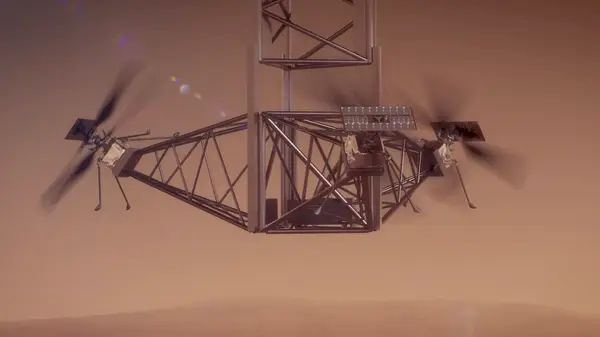
The legacy of ingenuity and the path to skyfall
Three years ago, the Ingenuity helicopter changed everything. It was a small, experimental craft that weighed about as much as a box of tissues. Most experts doubted it would survive even a single flight in the thin Martian atmosphere.
Ingenuity did not just survive; it thrived. It completed 72 flights, far exceeding its original five-flight mandate. The tiny drone showed us that aerial scouts are the best way to map terrain that ground rovers simply cannot reach.
Now, NASA is looking toward the SkyFall mission. This next phase aims to send three larger, more capable helicopters to the surface. They will ride a nuclear-powered spacecraft to the red planet, likely launching as soon as 2028.
SkyFall is a massive jump in scale. These new ships will carry heavier sensors and better batteries to traverse vast distances. The engineering team knows that if they want to move more weight, they need more lift, and that means spinning rotors at extreme speeds.
Breaking the sound barrier in a vacuum
The challenge with flying on Mars is the density of the air. It is roughly one percent of what we have at sea level on Earth. To generate enough lift, rotors must spin incredibly fast compared to a standard helicopter.
Ingenuity played it safe. Its blades spun at 2,700 rpm, keeping the tips at about Mach 0.7. Engineers were terrified that if they hit Mach 1, the carbon-fiber blades would disintegrate. The physics of sound and rotation are unforgiving.
The team at JPL and AeroVironment decided to stop playing it safe. They built a test chamber to simulate the Martian environment and cranked the speed. They were ready for failure, even lining the room with metal to catch flying shards of blade.
The results were great. The rotors reached Mach 1.08 without breaking. They even simulated Martian headwinds to see if the blades would snap under the extra pressure. The design held firm, allowing for a 30 percent boost in total lift capability.
This success changes the math for future missions. With higher lift, we can pack these drones with specialized cameras, drills, and scientific gear. We are no longer limited to tiny, lightweight cameras. We can send real labs into the sky.
Technical specs of the new rotor design
The new rotors are longer than the ones used on Ingenuity. This change allows the blades to achieve higher lift at lower revolutions per minute, which helps with structural integrity. The tests showed that the three-bladed design works well for post-SkyFall projects.
The two-bladed design for SkyFall is also optimized for efficiency. Engineers discovered that by pushing the tips to Mach 1.08, they could unlock performance levels previously thought impossible. The data from these runs is still being processed by the team.
Testing involved thousands of rotations in a controlled vacuum. The control room team watched the data in real-time as the rpm hit 3,750. When the fan kicked on to simulate wind, the stress on the materials increased, but the blades remained stable.
This data provides a blueprint for future aerospace designs. It proves that we can operate at supersonic speeds on other planets without losing our hardware. It is a vital milestone for anyone building the best drones for planetary research.
The future of planetary aerial exploration
NASA is not stopping at Mars. The Dragonfly mission is currently in the works, heading for Saturn's moon, Titan. While Titan has a thicker atmosphere, the sheer scale of that mission requires massive engineering expertise.
The lessons learned in the JPL vacuum chamber apply to almost every future flight project. If you can make a blade survive the speed of sound, you can build a more durable ship for any environment. This is how we move from exploration to colonization.
We are waiting for the 2028 launch date with high expectations. The SR-1 spacecraft will carry these new drones into the void, marking a new phase of the space race. The technology we use to fly on Mars today will look like a toy tomorrow.
The path forward is clear. We need heavier payloads and longer range. With these new rotors, the engineers have gave the lift needed to reach those goals. The sky is no longer the limit; it is the starting line.
Frequently asked questions
- Why do rotors need to spin faster on Mars? Because the atmosphere is so thin, the blades need to move much faster than they would on Earth to generate enough lift to push the craft off the ground.
- What is the significance of Mach 1? Breaking the sound barrier creates shockwaves that can shatter materials. Keeping blades below this speed was a safety rule until this recent testing proved we could go faster.
- How many helicopters will go on the SkyFall mission? NASA plans to deploy three of these new, larger helicopters to explore the Martian surface once the SR-1 spacecraft arrives.
- Why was Ingenuity considered a success? It was designed for five flights but ended up completing 72 missions over several years, proving that aerial exploration of other worlds is a viable strategy.
- What is the next target after Mars? NASA is developing the Dragonfly mission to explore Titan, one of Saturn's moons, using a much larger rotorcraft than anything sent to Mars so far.
Expert take: my perspective
I think the most impressive part of this story is the sheer guts of the engineering team. They literally lined the test chamber with metal because they expected the blades to explode. That is the kind of raw, trial-and-error science that moved the space program forward in the sixties.
The thing that gets me is how we treat "supersonic" as a scary barrier. In the early days of aviation, people thought sound was a wall you could hit. Now, we are casually spinning carbon-fiber blades through that same wall in a vacuum just to see what happens. It is wild.
I believe this breakthrough is more important than the actual drones themselves. If we can master high-speed flight in thin air, we can adapt this for other moons and planets with similar conditions. This is the foundation for a whole fleet of autonomous scouts.
My only worry is the budget. We have the tech, but do we have the political will to keep funding these missions? I hope so. Watching a drone fly over a crater millions of miles away is the best use of our collective brainpower, and I want to see more of it.